Parents of a baby turning 6 months: the pediatrician, Instagram and grandma all say something different?
No more searching before every meal. One page a day tells you what to serve, how to cut it, how much, and what to do if it isn't working.
Get the plan — $47
Instant download · Read on any phone or print it
parents and caregivers say there is more conflicting advice than ever. 6 in 10 say it makes them doubt their own instincts.
Akron Children's survey of 1,002 U.S. parents and caregivers, April 2026.
Every source holds a piece of the puzzle. The pediatrician has a few minutes at the checkup. Social media has a thousand opinions. Grandma remembers how it was done thirty years ago.
Nobody hands parents the whole picture in order: what to serve today, how to cut it, how much, and what to do if it doesn't go to plan. So every meal starts with another search.
It isn't a parenting problem. It's a missing plan.
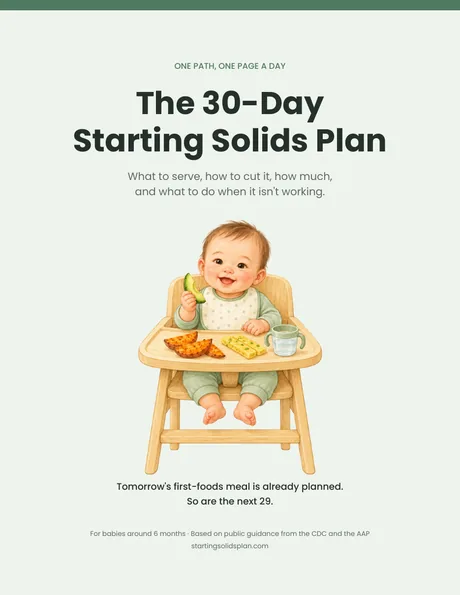
The 30-Day Starting Solids Plan takes the public guidance from the CDC and the American Academy of Pediatrics and turns it into one path: one page a day, in order, for thirty days.
One new food every 3 days, the rhythm the CDC and the AAP recommend so you can spot a reaction. In 30 days your baby meets 10 first foods, including the four common allergens egg, peanut, dairy and wheat, and moves from one meal a day to two.
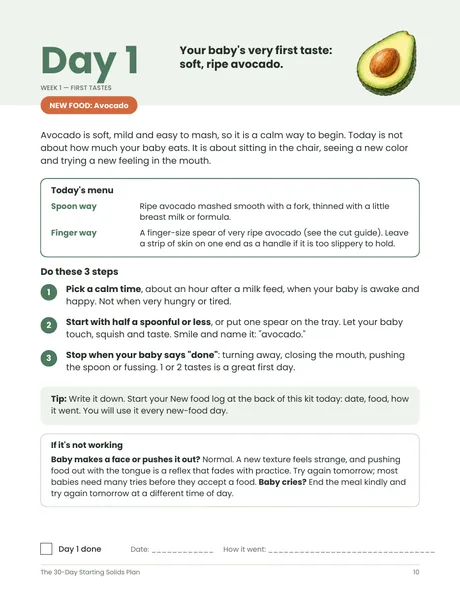
Thirty day pages in order: today's menu (spoon way and finger way), three steps, a tip, and an "if it's not working" box. Iron-rich foods early, allergens one at a time, a second meal from Day 15.
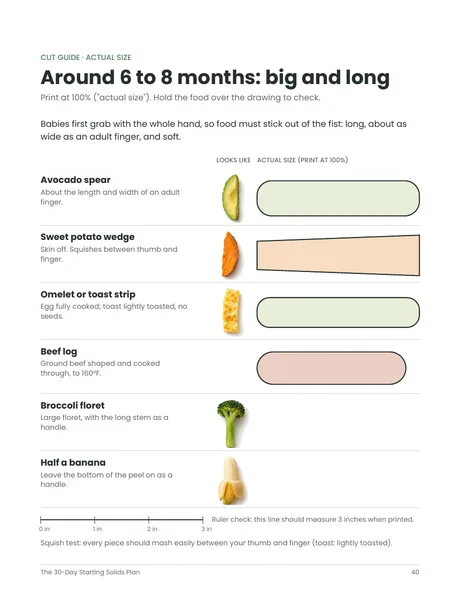
Photos of how each first food is cut, next to a drawing at actual size: hold the food over the page to check. Stage 1 (big and long) and stage 2 (small and soft), plus which round foods always get cut or flattened.
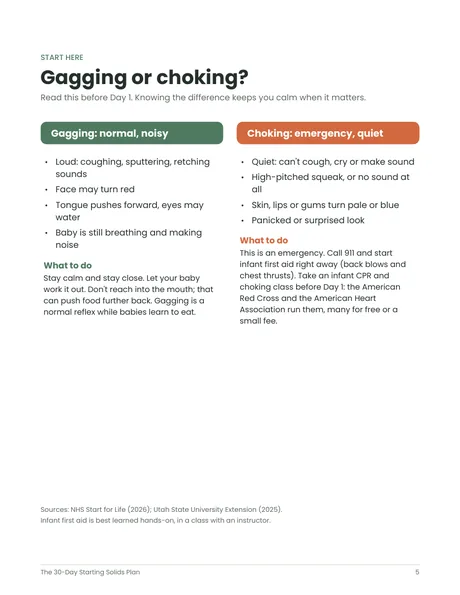
How the normal gag reflex looks and sounds, how choking is different, and what to do for each. Read it before Day 1.
How to serve 62 foods at around 6–9 months and around 9–12 months: vegetables, fruits, proteins, dairy and grains. For the months after Day 30.
One-hour batch prep for a week of meals, how to store and warm food, a daycare card to fill in, and weekly shopping lists.
No salt, no sugar, no honey. Plus amounts and hunger signs, quick help for refusing, gagging, throwing and missed days, a 30-day tracker, a new-food log and an allergen calendar.
Sources: CDC, When, What, and How to Introduce Solid Foods · AAP, Starting Solid Foods. This plan is not made, reviewed or endorsed by the CDC or the AAP.
Your baby has met 10 first foods, including egg, peanut, dairy and wheat.
Two meals a day are a routine, not a project.
You know what normal gagging looks like.
And you know what to serve next, without searching.
That's what one page a day adds up to.
One payment · Instant download · Yours to keep
That's about $1.57 a day for the 30 days. For comparison, popular first-foods plans and online courses sell for $49.99 to $59 (prices checked October 2026).
Get the 30-day planRead it on your phone or print it.
Follow the plan with your baby. If it isn't right for your family, email us within 30 days of buying and we'll refund you in full. No forms, no questions, nothing to send back.
Babies around 6 months who show the signs of readiness: sitting up with a little support, steady head and neck, opening the mouth for food and bringing things to the mouth. The plan has a checklist of the CDC's signs, and the CDC advises not starting before 4 months.
Both. Every day's menu has a spoon way and a finger-food way, and you can use one, the other, or mix them in the same meal. There's no single right way; the plan just tells you exactly how to do the one you pick.
Yes. Egg, peanut, dairy and wheat come in during the first month, one at a time, mixed with a food your baby already had, with what to watch for after. Babies with severe eczema or a past food reaction should get a plan from their pediatrician first, as the AAP and the CDC advise, and the plan tells you that before each allergen day.
No. No guide can, and we won't pretend to. What the plan does is show the shapes and sizes that match a baby's skills, the foods on the CDC's choking-hazard list and how to change them, how the normal gag reflex differs from choking, and what to do for each. It also recommends an infant CPR and choking class before Day 1.
On purpose. The CDC and the AAP advise one new food at a time and waiting 3 to 5 days before the next, so you can tell what caused a reaction. The plan follows that rhythm, and gives you the 62-food serving guide to keep going the same way after Day 30.
Yes. There's a one-hour batch-prep plan for the week, freezer portions, a day for packing a meal, and a daycare card so the caregiver knows how to serve each food.
One 61-page PDF. It arrives by email a few minutes after your order, and you can open it on a phone, tablet or computer, or print it. Nothing is shipped.
No. It is general information about feeding healthy babies, based on public guidance from the CDC and the AAP. It doesn't replace your pediatrician. If your baby was born early, has a health condition or has trouble swallowing, talk to your pediatrician before starting.
Email us within 30 days and you get your money back in full.
No. One payment, and the file is yours to keep.

Open today's page. Tomorrow's is already there.
Get the 30-day plan — $4730-day refund · Instant download